.jpg)
According to industry body Society of Indian Automobile Manufacturers and Automotive Component Manufacturers Association of India, with demand continuing to be low and factories not operating at full scale, this may lead to temporary excess overheads.

India's economic growth slowed to 7 per cent in the three months through June from 7.5 per cent in the previous quarter
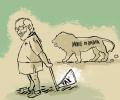
'The most important thing to do is to stop taxing citizens so brutally,' recommends T C A Srinivasa-Raghavan.

India has been able to attract 40 global smartphone makers to the country -- creating at least 50,000 jobs. But GST could hurt that, discovers Ayan Pramanik.

The previous high GDP growth of 8.1 per cent was recorded in April-June quarter of 2016-17.

These five stocks, which have lagged the markets over the last two years, have doubled in value since March 23.
Growth in factory output, as measured by the Index of Industrial Production, was higher at 6.7 per cent in February 2011.

India's GDP growth has slowed down to 6.9 per cent in second quarter of 2011-12 from 8.4 per cent in corresponding period of previous year.

Strong foreign fund inflows, a weakening dollar and slipping oil prices propped up the local unit.

Terming the slowdown in May industrial output as "not encouraging", Finance Minister Pranab Mukherjee on Tuesday said the government was in the process of taking steps to enhance the productivity of the manufacturing sector.

The RBI on Friday said the impact of coronavirus outbreak on the economy will depend on the intensity, spread and duration of the deadly virus even as the central bank refrained from projecting any numbers for growth and inflation amid the widespread uncertainty. While announcing the seventh bi-monthly monetary policy statement for 2019-20, RBI Governor Shaktikanta Das said that in view of the impact of coronavirus pandemic, the growth projections for 4.7 per cent for the fourth quarter of 2019-20 and 5 per cent for the full fiscal are "now at risk".

Other major laggards were IndusInd Bank, SBI, Bharti Airtel, ONGC, Tata Steel and Reliance Industries -- falling as much as 6.30 per cent.
Amid decelerating economic growth and falling industrial output, India's services sector has shown signs of promise in May recording the fastest pace of growth in the past three months, says an HSBC survey.
For April-July period, the output went up by 9.6 per cent against 10.6 per cent.
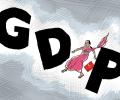
'One cannot take it that the economy has recovered, and the GST payment has increased because of that, or that production is back to January 2020 level.'
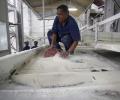
Record sugar output has also yielded molasses production way beyond market demand and plant capacity of state distilleries and country made liquor units
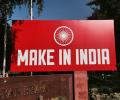
Without reforms to boost returns for multinational capital, Narendra Modi's 'Make in India' campaign will face testing times.

The consumer durables segment declined by 23.4 per cent in June, as against a dip of 10.1 per cent a year ago.

The economic activities that registered growth of over 6 per cent in the second quarter are manufacturing, electricity, gas, water supply, other utility services and trade, hotels, transport and communication, and services related to broadcasting.
With total sales of 2, 11,402 cars, compared to 1, 86,890 notched up in the same month last year, February 2012 witnessed the highest growth in the last 10 months in terms of sales output.
However, growth in factory output in January, as measured in terms of the Index of Industrial Production, was better than the 2.53 per cent expansion (revised upward from 1.6 per cent) witnessed in the previous month.
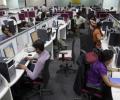
Business confidence remained positive in August and was driven by upbeat forecasts of sales, an expected improvement in demand and promotional activities
IIP growth has been revised upwards to 2.5 per cent in December, from the provisional estimates of 1.8 per cent.
The Society of Indian Automobile Manufacturers had earlier revised the sales forecast for financial year 2012 downwards for the passenger cars at 10-12 per cent in July against 16-18 per cent announced at the beginning of the fiscal.

Factory output, measured in terms of Index of Industrial Production, showed an improvement mainly because of an uptick in mining and manufacturing production and larger offtake of capital goods.

A reading below 50 means contraction in the sector.

At Rs 56,990, the smartphone seems to be on the pricier side.

A recent data released by the Central Statistics Office (CSO) confirm that both the manufacturing and mining sectors shrunk in 2013-14 with fall in output.

After the 2019 election, one thing is sure: GST will see a number of changes, explains Indivjal Dhasmana.

On the employment front, services employment was unchanged in April.
Domestic passenger car sales declined by 23.77 per cent to 1,38,521 units in October, 2011, from 1,81,704 units in the same month last year.

Companies, so far, were constrained by the provisions of Articles 370 and 35A, which restricted the purchase of land and hiring manpower.

The slowdown has mainly been on account of poor performance by the manufacturing and mining sectors.

Japanese auto giant Honda on Thursday said it will set up a third two-wheeler manufacturing facility in India at Narsapuram, in Karnataka, with an installed annual capacity of 12 lakh units by 2013.

The delivery of the Tejas Light Combat Aircraft (LCA) to the Indian Air Force under a Rs 48,000-crore deal will begin from March 2024 and around 16 aircraft will be rolled out annually till the completion of the total supply of 83 jets, Chairman and Managing Director of Hindustan Aeronautics Limited R Madhavan said on Sunday.

With the world's worst outbreak of COVID pandemic stalling a nascent economic recovery, the government has begun assessing the impact of the second wave of infections on different sectors and may look at providing support at an appropriate time to segments requiring fiscal help. Some of the economic indicators, including the Goods and Services Tax (GST) collections, still provide confidence and incoming data will throw some more light on the state of the economy, sources said. Services sectors like hospitality, tourism and aviation which had just started recovering were hit hard by the second wave of COVID, the sources said, adding these segments might need some support on an urgent basis from the government.
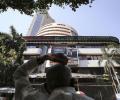
Adani Ports, HUL and L&T gained the most, while ICICI Bank, ONGC, GAIL and Tata Steel lost the most

Continuing decline in food prices, including vegetables, pulled wholesale price inflation to a five year low of 1.77 per cent in October.
Issues relating to shortage of key automotive components, which were supposed to be sorted out a month ago, will hit production even for the next two quarters, as slow ramp-up and discrepancies in tyre prices impact output.
Industrial growth in the country revived moderately to 8.8 per cent in June this year on the back of a smart recovery in the manufacturing sector and better offtake of capital goods.
